Traditional Kratom Tea vs. US Kratom Products: What Researchers Found
Researchers examining traditional kratom preparations in Southeast Asia highlight important chemical differences between fresh-leaf tea and products sold in the United States, including preliminary findings about 7-hydroxymitragynine.
Not All Kratom Products Are the Same
Kratom has been consumed in Southeast Asia for generations, often by chewing fresh leaves or preparing them as a tea. Today, American consumers encounter kratom in several different forms, including dried-leaf powders, capsules, concentrated extracts, and products containing chemically modified alkaloids.
But are these products chemically equivalent?
A paper published October 20, 2026, in the Journal of Addiction Medicine examines that question, emphasizing differences between traditionally prepared kratom and commercially available US products.
The authors focus particularly on fresh-leaf kratom tea and two aspects of its chemistry: how mitragynine occurs in the preparation and whether 7-hydroxymitragynine (7-OH) is detectable.
What Did Researchers Find?
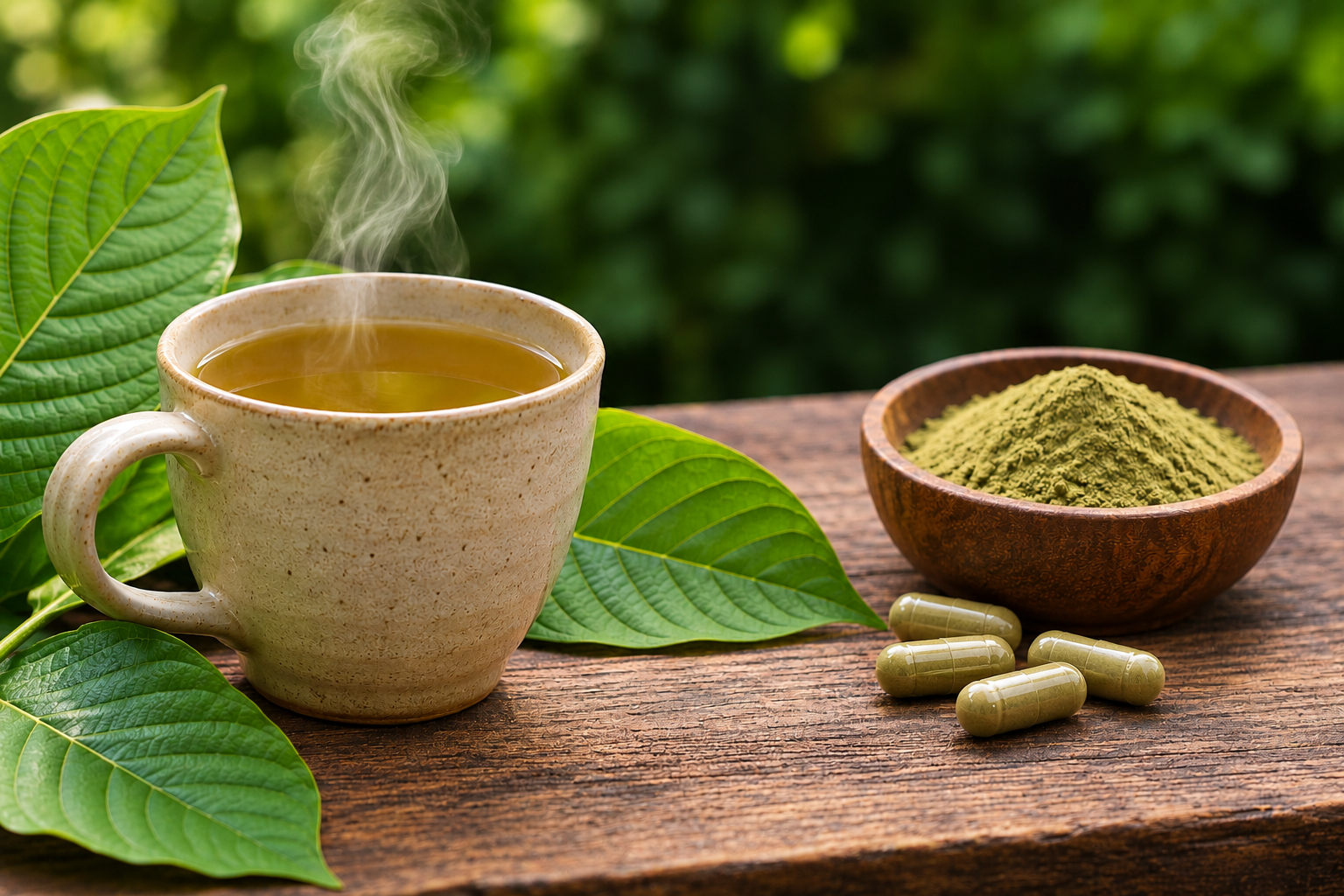
The authors describe a traditional preparation made by boiling freshly harvested, unprocessed kratom leaves in water.
They report that mitragynine and related alkaloids occur in this preparation as water-soluble organic salts rather than as isolated, pure base alkaloids.
That distinction concerns the chemical form of the compounds. It does not, by itself, establish that traditional kratom tea is stronger, weaker, safer, or more effective.
The second finding is particularly noteworthy.
The authors report that their preliminary evaluation did not detect 7-hydroxymitragynine in the fresh-leaf preparation.
7-OH is a potent alkaloid associated with kratom. Although it can occur naturally in small amounts, it is also found at substantially elevated concentrations in certain commercially processed products.
The reported non-detection is interesting because it adds to the discussion about differences between traditional kratom preparations and products containing concentrated or modified alkaloids.
However, the abstract does not provide the testing method, detection limit, or enough experimental detail to determine whether the same result would occur with other fresh-leaf preparations.
Why This Matters for US Kratom Consumers
One of the paper's central arguments is that the term kratom now describes products that can differ substantially in their chemical composition.
Traditional fresh-leaf tea is not necessarily equivalent to dried-leaf powder, concentrated extracts, or products containing chemically modified alkaloids.
That distinction matters when interpreting scientific findings, evaluating product testing, or discussing kratom safety.
For example, findings involving a highly concentrated 7-OH product should not automatically be assumed to apply equally to ordinary dried kratom leaf. Likewise, observations about traditional fresh-leaf tea cannot automatically establish the safety of dried-leaf products.
Understanding what was actually tested is essential.
What the Research Doesn't Establish
The authors suggest that differences in chemical composition may contribute to differences in safety between traditional preparations and US kratom products.
However, the publicly available abstract does not establish that traditional fresh-leaf tea is safer than dried kratom powder or other preparations.
It also does not provide a controlled comparison of health outcomes across these product categories.
The findings concerning 7-OH are explicitly described as preliminary, and the full paper was not reviewed for this article.
The Bottom Line
Kratom's chemical composition can differ depending on how the plant is prepared and processed.
This paper highlights two important observations about traditional fresh-leaf tea: the reported presence of water-soluble alkaloid salts and preliminary non-detection of 7-hydroxymitragynine.
More broadly, it reinforces an important distinction for consumers and researchers alike: traditional kratom preparations, natural dried-leaf products, concentrated extracts, and chemically modified products should not automatically be treated as interchangeable.
That distinction deserves attention as scientific research and regulatory discussions continue.
Source
Karunakaran T, Vicknasingam K, Chawarski MC. Kratom-labeled Products in the US Compared With Traditionally Consumed Natural Kratom in Southeast Asia. Journal of Addiction Medicine. Published October 20, 2026.
Evidence note: This article is based on the published abstract. The full paper was not reviewed, and the abstract does not supply detailed analytical methods or quantitative results.
The source trail
References & further reading
Sources cited in this article. Links do not imply endorsement of Kratom Expert.