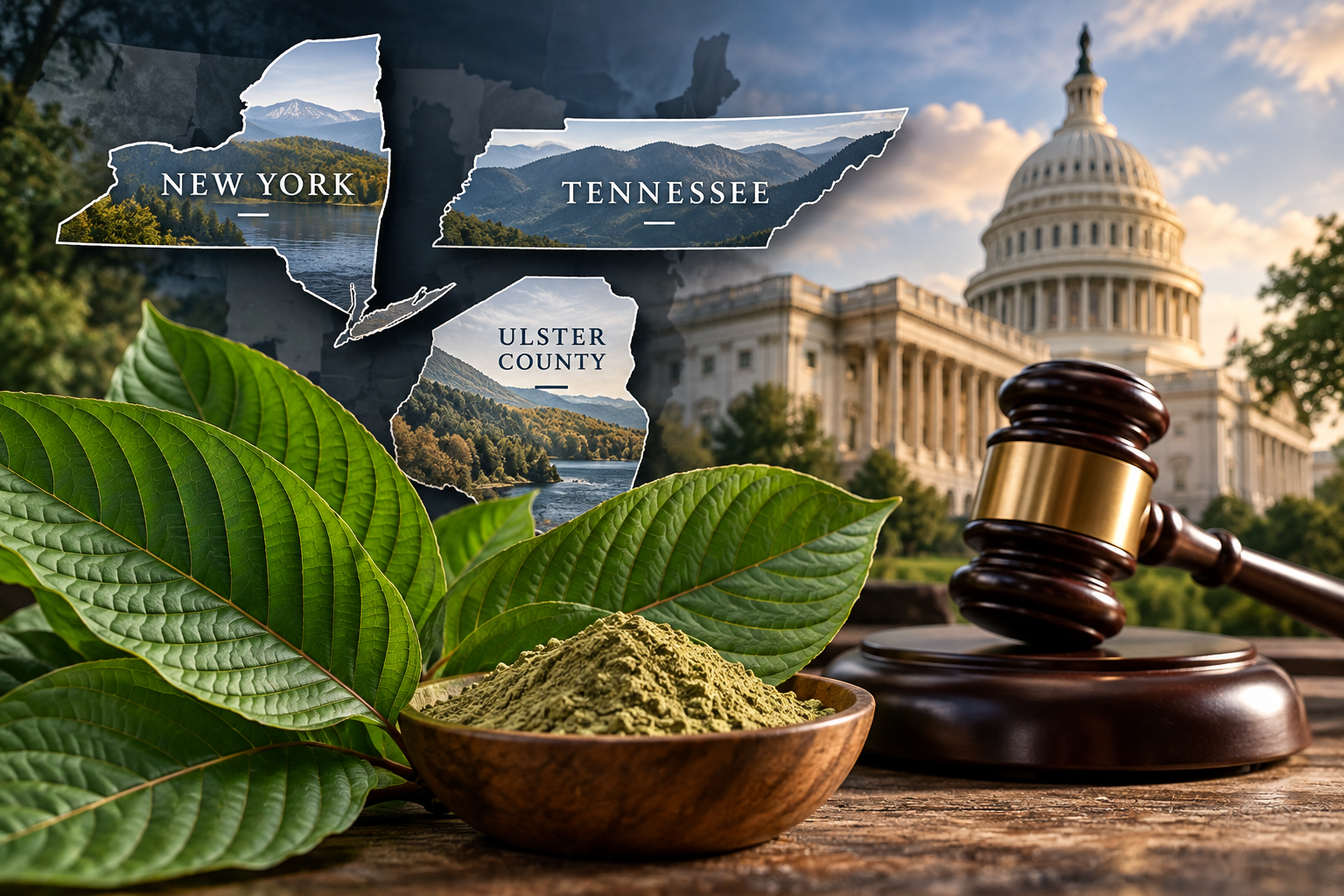
Kratom regulation in 2026 is developing on several fronts across the United States. Federal agencies have outlined new scheduling thresholds intended to distinguish natural kratom leaf from products containing elevated concentrations of certain opioid-active compounds. Meanwhile, officials in Georgia and Florida are considering additional retail restrictions.
These developments highlight an important question: How should lawmakers distinguish traditional botanical kratom from concentrated or chemically altered products?
Federal Agencies Propose New Scheduling Thresholds
On October 14, 2026, the Drug Enforcement Administration (DEA) published a revised notice of intent concerning two kratom-related compounds: 7-hydroxymitragynine (7-OH) and mitragynine pseudoindoxyl (MGPI).
The notice follows updated recommendations submitted by the Department of Health and Human Services (HHS) on October 8.
Under the proposed framework, Schedule I controls would apply when either compound, or their combined amount:
- Exceeds 1 milligram per gram in solid products or 1 milligram per milliliter in liquids.
- Results in a mitragynine-to-7-OH/MGPI mass ratio below 100:1.
Meeting either condition would trigger the proposed controls.
These thresholds recognize measurable differences between ordinary botanical kratom and products with elevated concentrations of 7-OH or MGPI.
As of October 27, these thresholds are a proposal, not an effective scheduling order. The notice provides for a temporary order on or after November 13, 2026; that is not a guaranteed effective date. Existing federal Schedule I controls on MGPI remain in place pending further DEA action.
Below-threshold products have not been declared safe or federally approved. Read the DEA notice and the DOJ explanation.
Georgia Attorney General Calls for Broader Restrictions
On October 23, Georgia Attorney General Chris Carr urged convenience stores to remove kratom products from their shelves.
Carr also called for legislation that would generally prohibit retail sales of kratom-derived products unless they appeared on a state-approved list.
Under the proposed system, products could be required to meet standards involving independent laboratory testing, accurate labeling, and federal marketing authorization.
Carr argues that Georgia's existing Kratom Consumer Protection Act does not adequately address public-health risks associated with kratom and concentrated 7-OH products.
However, the proposed approval-list system could extend beyond concentrated products to natural kratom leaf.
As of October 27, Carr’s approval-list restriction remains a legislative proposal, rather than an enacted requirement. Read the attorney general’s statement.
Florida: Hillsborough County Schedules November 10 Hearing
Hillsborough County, Florida, is considering amendments to its local synthetic-drug ordinance addressing certain kratom products.
Commissioners approved scheduling a November 10, 2026 public hearing at their October 21 meeting. The county’s official recap, dated October 26, confirms approval of consent items A-1 through A-62, including the kratom proposal in A-5.
The county’s October 21 draft ordinance exempts whole-leaf kratom, including raw or dried leaves intended to be chewed, crushed, or steeped in tea. It also exempts products that are not chemically enhanced, chemically altered, or otherwise concentrated for increased potency.
The draft would require permitted retail food establishments selling kratom in any form, including whole leaf, to display a warning sign next to the product. The sign would address the age-21 sales restriction, identification requirements, and potential serious adverse health effects.
The treatment of individual preparations depends on the draft’s definitions and exemptions, and commissioners could revise the text before adoption. As of October 27, this is a proposed county ordinance.
Meeting details:
- Date: Tuesday, November 10, 2026
- County commission meeting: 9:00 a.m. Eastern
- Proposed ordinance hearing: 10:00 a.m. Eastern, as specified in the county’s ordinance materials
- Location: County Center, 2nd Floor Boardroom, 601 E. Kennedy Blvd., Tampa, FL 33602
The county is accepting public participation through its established meeting procedures.
What These Developments Mean for Natural Kratom
The federal and state developments illustrate different approaches to kratom regulation.
At the federal level, regulators are proposing measurable chemical thresholds for determining when 7-OH and MGPI fall under Schedule I controls.
Georgia is considering a broader retail approval system, while Hillsborough County is evaluating restrictions with an exemption for whole-leaf products.
Public-health officials cite concerns about dependence, adverse reactions, and concentrated opioid-active substances. Kratom advocates argue that regulations should recognize differences between natural botanical products and chemically enhanced formulations.
For consumers and businesses, the distinction between these product categories remains central to the regulatory debate.
Make Your Voice Heard
As federal and state officials consider new kratom regulations, consumers, families, and businesses can share their perspectives with elected representatives.
The American Kratom Association is encouraging public participation in discussions about synthetic and concentrated kratom compounds and access to natural botanical kratom.
Contact Congress — Support Stopping Synthetics, Not Natural Kratom Access
Contact Congress through Protect Kratom’s active action form
The page currently hosts an American Kratom Association advocacy form asking Congress to reject Rep. Harris’s letter and support science-based kratom policy.
Readers can also contact their congressional representatives directly to share their views on the proposed regulations.
Kratom Expert provides this resource for public awareness and does not require readers to support any particular legislative position.
The source trail
References & further reading
Sources cited in this article. Links do not imply endorsement of Kratom Expert.
- Federal Register — DEA Notice of Intent, October 14, 2026
- Department of Justice — Updated Emergency Scheduling Actions
- Georgia Attorney General — October 23, 2026 Statement
- Hillsborough County — November 10 Board of County Commissioners Meeting
- Hillsborough County — October 21, 2026 Agenda
- Hillsborough County — Draft Ordinance and Business Impact Estimate, Item A-5
- Hillsborough County — Official October 21 Meeting Recap, Dated October 26
- Protect Kratom — Contact Congress Action Form