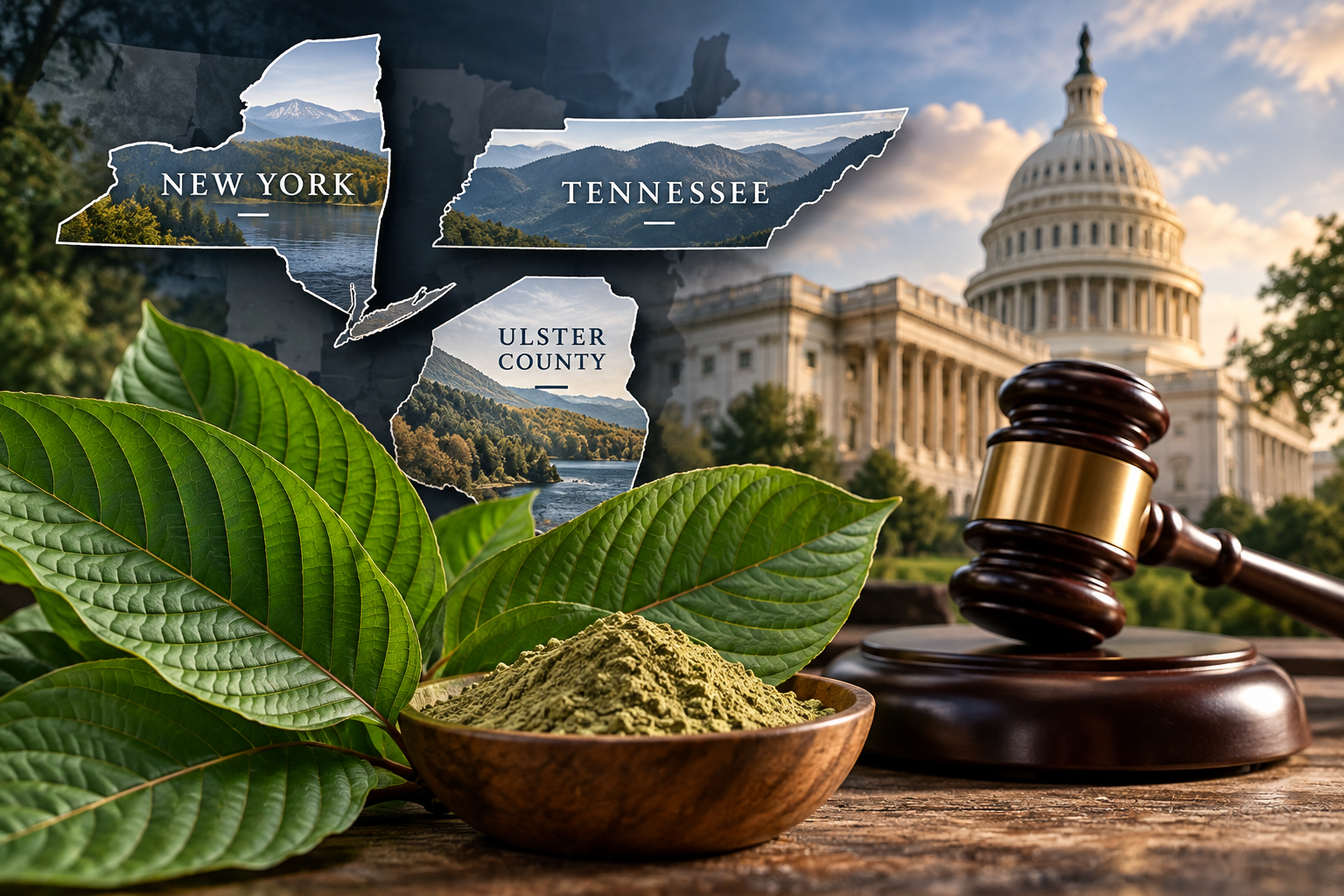
Kratom regulation continues to evolve across the United States, with local governments and state agencies taking different approaches to traditional kratom leaf and concentrated alkaloid products.
Recent developments highlight a growing distinction between measures targeting 7-hydroxymitragynine (7-OH) and broader restrictions affecting products containing naturally occurring mitragynine.
Saratoga County, New York: Kratom Sales Ban Adopted
On October 20, 2026, the Saratoga County Board of Supervisors adopted Local Law No. 7 of 2026, prohibiting the commercial sale and distribution of kratom products within the county.
The restriction extends beyond concentrated 7-OH products to include traditional kratom leaf and other products derived from the plant.
The measure represents a broader regulatory approach than restrictions aimed exclusively at synthetic or concentrated alkaloids.
Status: Adopted October 20, 2026.
Effective date: The law takes effect upon filing with the New York Department of State. The filing date has not been independently established.
Official source: Saratoga County — Local Laws
Tennessee: Workplace Rulemaking Follows Statewide Kratom Ban
Tennessee's statewide kratom prohibition took effect July 1, 2026, covering possession, manufacture, and sale of kratom, including natural leaf products.
The Tennessee Department of Labor and Workforce Development has scheduled a public rulemaking hearing for November 10, 2026.
The proposed amendments would explicitly include kratom within the definition of a drug under the state's Drug-Free Workplace Program.
These amendments concern workplace regulation and implementation of existing law. They do not constitute a new statewide prohibition.
Status: Proposed administrative rule.
Hearing: November 10, 2026, at 11:00 a.m. Central Time.
Official sources:
- Tennessee Department of Labor — Rulemaking Hearing
- Tennessee Department of Mental Health — Emerging Substances
Ulster County, New York: Concentrated 7-OH Restrictions Under Consideration
Ulster County is considering Proposed Local Law No. 16 of 2026, which would prohibit the sale and distribution of concentrated and synthetic 7-hydroxymitragynine products.
Resolution No. 480.1, concerning a public hearing on the proposal, advanced through committee consideration on October 15.
The proposed hearing date is November 17, 2026, at 7:05 p.m. However, the official legislative record continues to list the resolution as pending.
Unlike Saratoga County's broader prohibition, Ulster County's proposal specifically addresses concentrated and synthetic 7-OH products.
Status: Pending legislation. No prohibition has been enacted through this proposal.
Official source: Ulster County Legislature — Resolution No. 480.1
Federal Scheduling: No New Action Confirmed This Week
At the federal level, the Drug Enforcement Administration's October scheduling proposals remain an important development for the kratom industry.
The proposals address 7-OH and related compounds, including mitragynine pseudoindoxyl.
The proposed concentration thresholds have not been established as operative law through a newly verified final order.
Existing scheduling restrictions remain separate from those proposals.
No additional substantive federal scheduling action was verified for the October 20–26 reporting period.
A Growing Difference in Regulatory Approaches
The latest developments demonstrate that kratom regulation is not following a single national model.
Saratoga County has adopted restrictions extending to traditional kratom products. Ulster County is considering a narrower prohibition focused on concentrated and synthetic 7-OH. Tennessee, meanwhile, is implementing workplace regulations following an existing statewide ban.
For consumers, manufacturers, and retailers, the distinction between ordinary leaf products and concentrated alkaloid formulations is increasingly important.
The scope of each measure depends on its specific definitions, legal status, and effective date.
As additional hearings and federal actions approach, those details will remain central to understanding how kratom regulation develops.
Editorial note: This regulatory update covers developments reviewed through October 26, 2026. Proposed measures are distinguished from adopted laws and existing restrictions. Effective dates are provided where established. This article is informational and does not constitute legal advice.
The source trail
References & further reading
Sources cited in this article. Links do not imply endorsement of Kratom Expert.