New Kratom Study Reveals Testing Challenges and Alkaloid Differences in Commercial Products
Researchers examining commercial kratom products identified differences in alkaloid composition between botanical materials and certain processed formulations, while demonstrating why accurate laboratory methods are essential for identifying 7-hydroxymitragynine.
A closer look at commercial kratom testing
A 2026 study published in the Journal of the American Society for Mass Spectrometry examines the challenges of identifying kratom alkaloids and the chemical differences found among commercial products.
Researchers from Ohio University and the American Herbal Pharmacopoeia examined authentic kratom leaf materials alongside 38 commercial kratom products representing multiple formulations.
Their investigation focused on several alkaloids, including mitragynine, 7-hydroxymitragynine (7-OH), and mitragynine pseudoindoxyl (MGP).
The researchers addressed two important questions: How can laboratories reliably distinguish chemically similar alkaloids, and what differences become apparent when commercial products are analyzed using more specific methods?
Why identifying 7-OH can be complicated
Kratom contains numerous structurally related alkaloids. Some share the same molecular formula or produce similar signals during mass-spectrometry analysis.
This similarity creates a challenge for laboratories attempting to identify individual compounds.
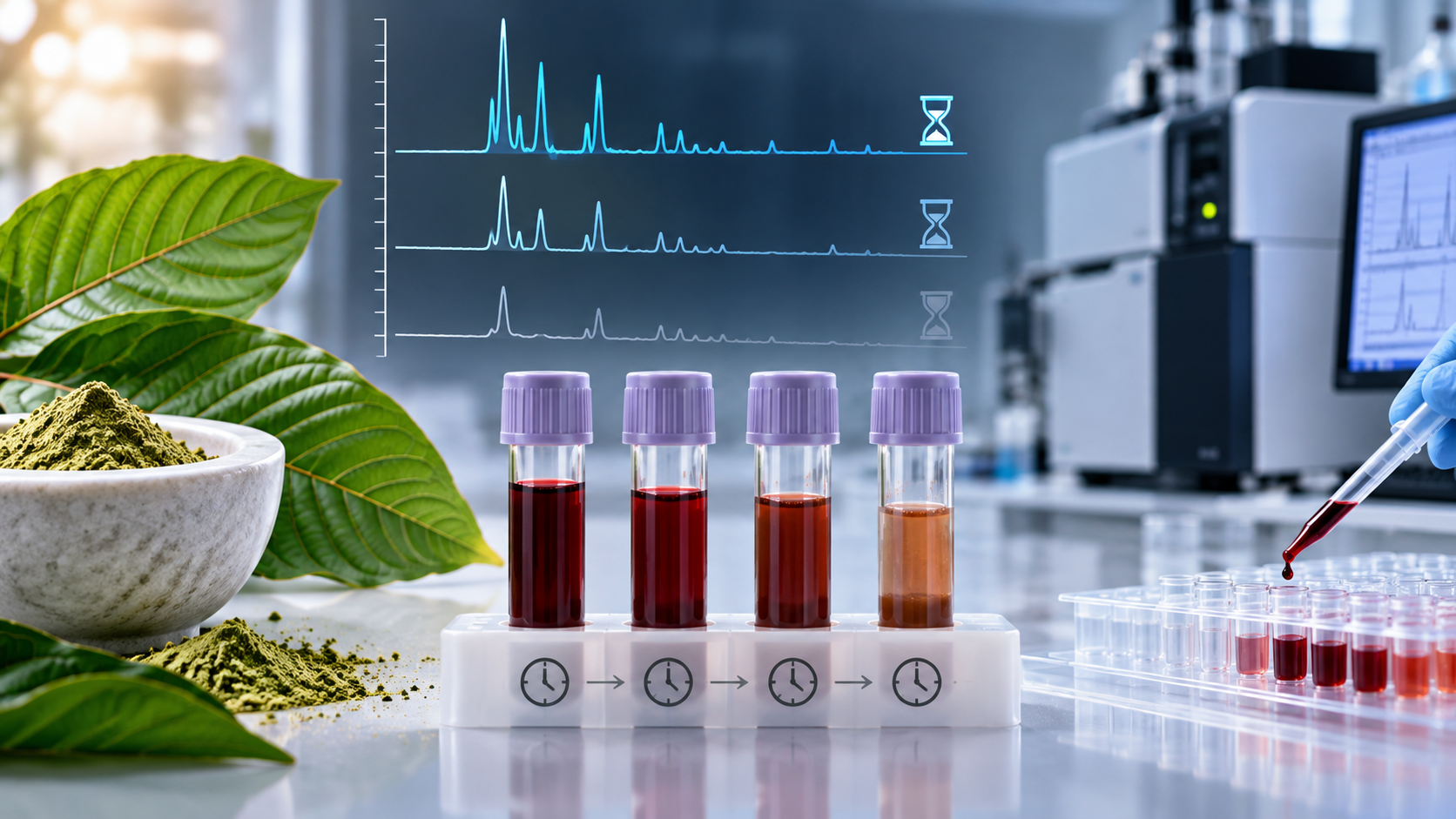
The researchers observed multiple chromatographic peaks associated with the same measured mass, including signals that could potentially be mistaken for 7-OH.
They demonstrated that relying on accurate mass alone, or on certain commonly monitored mass-spectrometry transitions, could produce a false-positive identification.
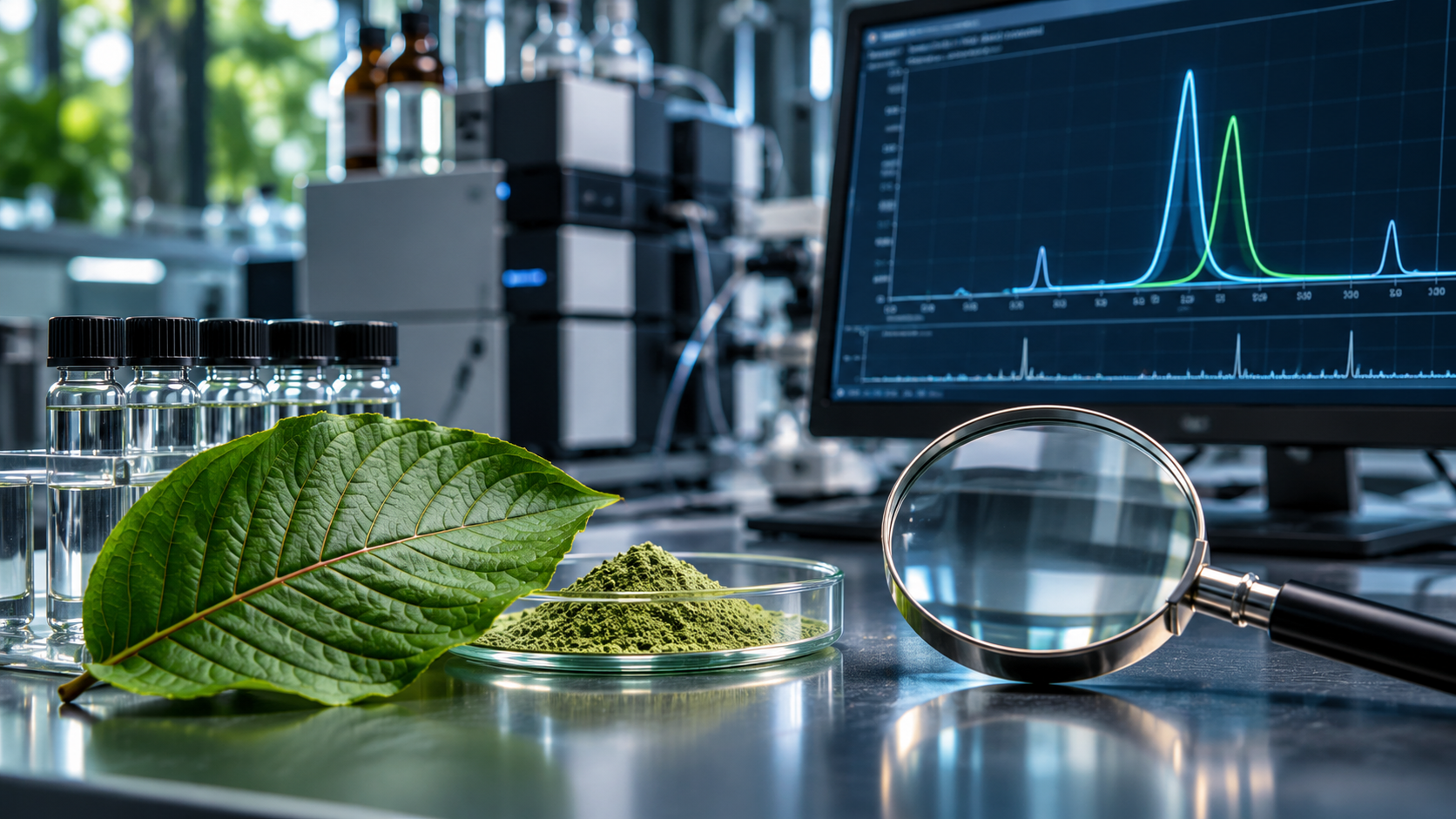
To address this problem, the researchers developed an analytical approach combining chromatographic separation, accurate mass measurement, and diagnostic tandem mass-spectrometry fragmentation.
Using multiple identification criteria allowed them to distinguish 7-OH, mitragynine pseudoindoxyl, and other related compounds more reliably.
The key finding isn't that commercial laboratories routinely report incorrect results. It's that accurately identifying 7-OH requires methods capable of distinguishing it from chemically similar compounds.
What researchers found in commercial products
Beyond investigating potential identification errors, the researchers examined the alkaloid composition of commercially available kratom products.
Their analysis revealed substantial variation across the products tested.
Importantly, the researchers confirmed the presence of 7-OH and mitragynine pseudoindoxyl in several commercial tablet and capsule formulations.
These findings establish that the study was not simply an investigation of possible false-positive results. It also demonstrated the ability of more specific testing methods to identify particular alkaloids in commercial products.
The published abstract does not establish how frequently these compounds occur across the entire kratom marketplace, nor does it provide an industry-wide estimate of product concentrations.
Nevertheless, the findings illustrate why verified chemical composition matters when evaluating different kratom formulations.
Natural leaf and processed products showed different chemical profiles
Another significant finding involved differences in the overall chemical composition of the products examined.
Using untargeted metabolomic profiling, the researchers compared patterns of chemical compounds across botanical materials and commercially processed formulations.
Their analysis distinguished kratom plant extracts, including authentic leaf materials, from processed products enriched in particular alkaloids.
This distinction matters because products marketed under the general category of kratom do not necessarily share the same chemical composition.
Natural botanical material contains a mixture of alkaloids and other plant compounds. Products enriched in specific alkaloids may have substantially different chemical profiles.
However, identifying those differences does not independently establish how a product was manufactured or whether a particular chemical synthesis process was used.
Why these findings matter
The study has implications for laboratories, manufacturers, consumers, and regulators.
For laboratories, it demonstrates the importance of using sufficiently specific methods to confirm alkaloid identity. A laboratory signal that resembles 7-OH is not necessarily sufficient to establish its presence.
For manufacturers, the findings highlight the importance of accurate chemical identification and reliable quantitative testing when documenting product composition.
For consumers, the research reinforces that natural-leaf kratom and products enriched in particular alkaloids should not automatically be considered chemically equivalent.
For regulators, the findings emphasize the value of reliable analytical evidence when evaluating products based on their alkaloid content.
There is also an important distinction between confirming a compound's identity and determining its concentration. Both may be relevant when laboratory findings are used to assess a product's composition.
The researchers' analytical approach helps address identification, but the study should not be treated as a comprehensive assessment of the accuracy of commercial kratom testing.
What the research does not establish
Although the findings are relevant to kratom testing, several limitations are important.
The study does not establish that laboratories routinely misidentify 7-OH.
It does not provide an industry-wide false-positive rate or demonstrate that particular vendors or laboratories have issued inaccurate results.
The findings also should not be generalized to every commercial kratom product. The researchers examined a defined set of samples, and other products may have different chemical characteristics.
Finally, the study focused on analytical identification and chemical composition. It did not directly evaluate the health effects or clinical safety of the products examined.
Those questions require additional research.
The bottom line
The significance of this research extends beyond the possibility of false-positive laboratory results.
Using multiple analytical criteria, researchers demonstrated a more reliable approach to distinguishing 7-OH from chemically similar compounds.
They also documented meaningful variation in the alkaloid composition of commercial kratom products, including the presence of 7-OH and mitragynine pseudoindoxyl in several processed formulations.
Together, these findings reinforce an important principle:
Reliable laboratory testing must establish what compounds are actually present before conclusions are drawn about a product's composition, labeling, or regulatory classification.
As the kratom marketplace continues to evolve, distinguishing natural botanical material from products enriched in specific alkaloids remains an important part of understanding what consumers are purchasing.
References & further reading
Primary scientific source
Sheehan, D., Li, Y., Meckler, E., Upton, R., & Zhang, M. (2026). Avoiding False Identification of 7-Hydroxymitragynine in Kratom Products Using a Multicriteria LC-MS Confirmation. Journal of the American Society for Mass Spectrometry, 37(5), 1303–1312.
DOI: https://doi.org/10.1021/jasms.6c00088
Editorial note: This article summarizes findings from one published laboratory study. Its reported findings were checked against the published abstract. The full-text results and supporting tables were not independently verified for this revision. This article is not an independent laboratory investigation, product evaluation, or clinical safety assessment.
The source trail
References & further reading
Sources cited in this article. Links do not imply endorsement of Kratom Expert.