What the study examined
A forensic study abstract describes a method for measuring four kratom-related alkaloids in blood and reports a substantial stability problem for one of them. The authors examined mitragynine, 7-hydroxy mitragynine, mitragynine pseudoindoxyl, and dihydro-7-hydroxy mitragynine. Their report combines analytical method development, stability measurements, and concentrations from more than 200 authentic cases. This is one study involving forensic casework and medicolegal death investigations, not a controlled human exposure study. Only its abstract was available in the supplied evidence. S1
The abstract abbreviates those compounds as MG, 7OH-MG, MP, and DH-7OH-MG, respectively, and also identifies DH-7OH-MG as MGM-15. It describes MG as the primary psychoactive component of Mitragyna speciosa and states that 7OH-MG occurs naturally in the plant in small amounts. The authors also distinguish botanical kratom from semi-synthetic alkaloid formulations marketed under the same umbrella term. That distinction matters to the scope of their report: its analytical targets are specific compounds, rather than a single undifferentiated measurement called kratom. S1
The authors describe MG metabolism to 7OH-MG and then MP, while specifically identifying in vitro enzymatic evidence for the latter step. That laboratory qualification should remain attached to the statement. The abstract does not establish that every MP measurement in a forensic specimen reflects the same biological pathway or timing. Its separate findings about instability and analytical interconversion make the origin of a measured compound an interpretive issue, rather than something a concentration alone resolves. S1
The reported blood-stability finding
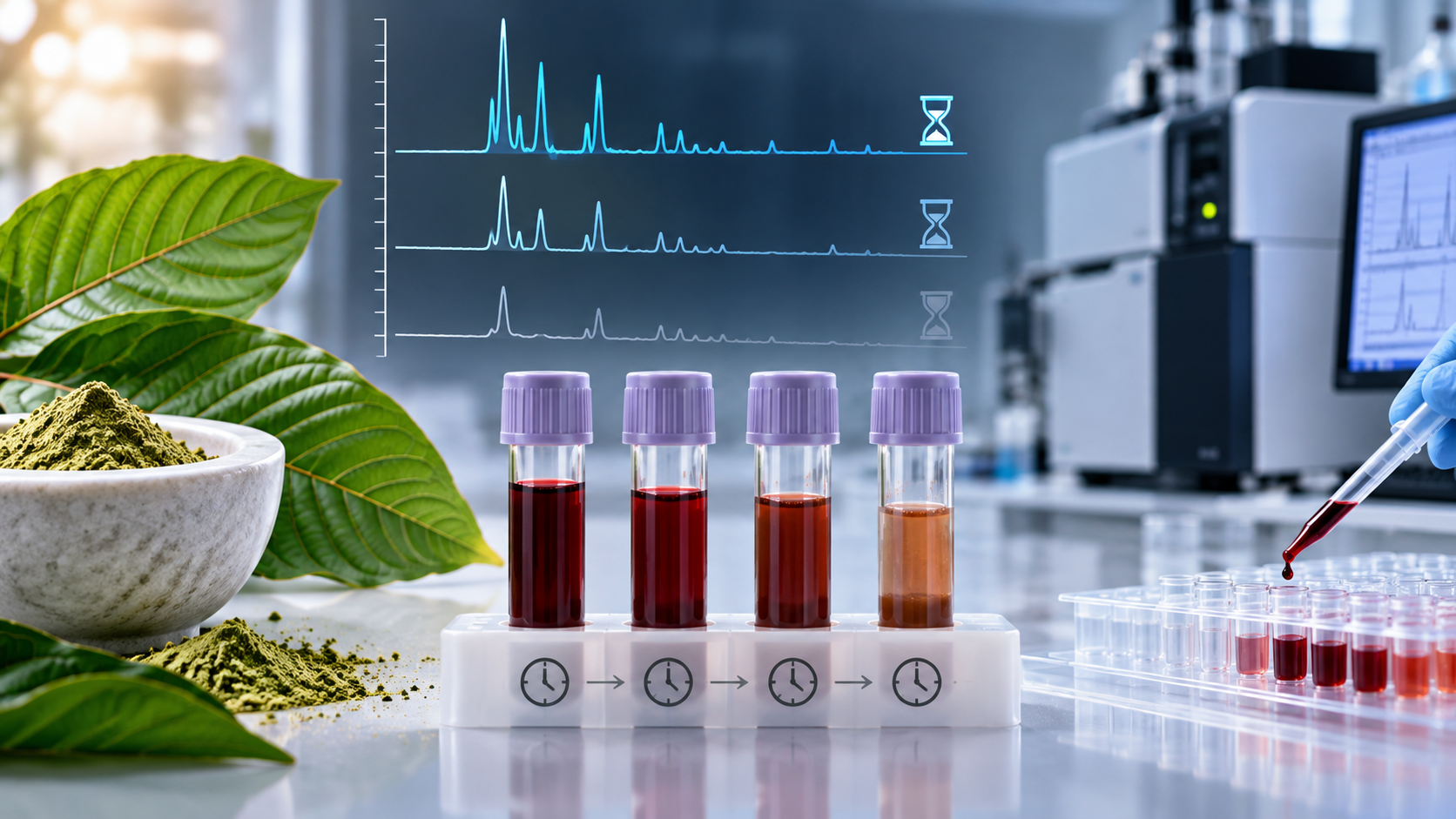
The authors report that 7OH-MG decreased by 89% over 112 days in blood, with a concurrent increase in MP. In contrast, they describe MG, MP, and DH-7OH-MG as relatively stable in blood. The word relatively is important: the abstract does not characterize those three compounds as unchanged under every condition. Its central stability finding is a contrast between the reported behavior of 7OH-MG and that of the other measured alkaloids. S1
The supplied abstract does not specify the storage temperature, preservative, container, or complete sampling schedule behind the 112-day result. Consequently, that percentage cannot be presented as a universal correction factor for forensic blood results. Nor does the abstract support a day-by-day estimate of loss or a calculation that reconstructs an earlier concentration from a later result. Those applications would require information beyond the reported endpoint and the authors’ general description of instability. S1
The concurrent increase in MP is also relevant, but the abstract does not provide a numerical conversion balance between the two compounds. It therefore supports reporting the paired observation without asserting that all lost 7OH-MG became MP. For interpretation, the narrower point is that the authors observed changing concentrations within blood specimens over time. Their findings do not establish a fixed relationship that can be applied to every case or used to infer an exposure history. S1
Why the analytical method matters
The authors identify several analytical challenges: isomeric forms, instability in blood, limited published concentration ranges, and extraction or instrumental techniques that can promote analyte interconversion. These are distinct concerns within the same testing problem. Instability concerns changes in the specimen, while the interconversion warning concerns changes associated with analytical procedures. According to the abstract, either issue can complicate interpretation, so the reported concentration cannot be considered separately from how the specimen was handled and analyzed. S1
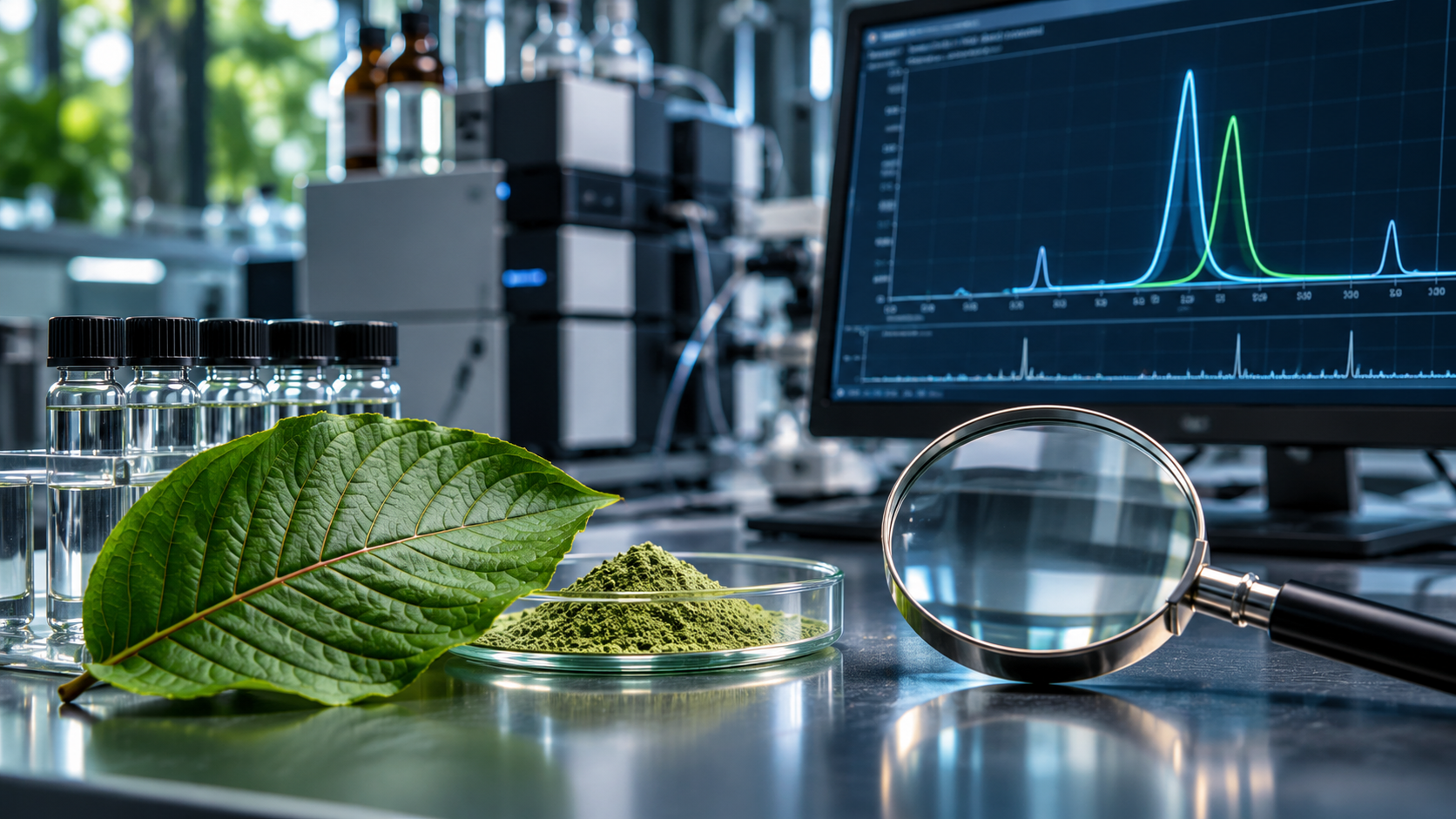
The abstract presents a quantitative high-resolution mass spectrometry method that the authors say prevents interconversion and separates isomers. Those are the method capabilities reported by the authors, not independently corroborated conclusions in the supplied evidence. The abstract does not provide the extraction procedure, instrument settings, calibration details, or complete validation results. It therefore identifies the method’s intended analytical advantages without supplying enough detail here to reproduce it or assess every aspect of its performance. S1
For a reader examining a forensic report, this study makes method-specific documentation relevant to understanding the result. The corresponding questions concern whether the reported method distinguishes the target compounds and addresses interconversion, and whether specimen handling is consistent with the available stability evidence. The abstract cannot answer those questions for another laboratory. It also does not establish that a laboratory using high-resolution mass spectrometry necessarily uses the particular procedure described by these authors. S1
What the case concentrations can and cannot establish
In a subset of 139 cases, the authors report mean ± SD blood concentrations of 146 ± 477 ng/ml for 7OH-MG and 194 ± 239 ng/ml for MP. The corresponding medians were 58 and 120 ng/ml, with ranges of 0–5000 and 4.8–1900 ng/ml. These are descriptive measurements from that case subset. The abstract does not identify them as diagnostic thresholds, concentration targets, or boundaries separating fatal from nonfatal exposure. S1
In a second subset of 17 cases, the authors report a DH-7OH-MG mean ± SD of 324 ± 669 ng/ml, a median of 170 ng/ml, and a range of 50–2900 ng/ml. The two subsets should not be treated as interchangeable populations. The abstract does not explain their selection in sufficient detail to establish how representative either is, and its total of more than 200 authentic cases does not mean every reported statistic includes every case. S1
The authors conclude that testing is limited and potentially inaccurate because of interconversion, leaving adverse events and fatalities under-investigated. That is their assessment from this report, not evidence here of independent scientific consensus. The abstract supports caution about analytical interpretation, but it does not establish a concentration-based cause of death, a clinical benefit, or a safety conclusion. Its strongest narrowly supported message is that specimen stability and analytical technique can affect the interpretation of these four alkaloids in forensic blood testing. S1
The source trail
References & further reading
Sources cited in this article. Links do not imply endorsement of Kratom Expert.